Yes, you need a content strategy!

contentMarketing products and services through smart and relevant online content is an absolute must nowadays. And yes, before you start creating content, it is absolutely vital that you you have a strategy in place.

It is about a systematic approach with which you can manage content across all channels, on- and offline, ensuring that you reach all customers. Developing a strategy will also allow you to create the type of content that your target audience is looking for and give you the opportunity to build thought leadership in your community.

When developing a strategy make sure to define why you are creating content and who you are creating it for. Do you know the information needs of your target audience and how they consume content?  Take the opportunity to see if your current content is creating the results that you expect or if readjustment need to be made.

If it is done correctly, a content strategy will help you analyze the effectiveness of your marketing campaigns. And you will provide your customers with something of value. And that in turn will translate into more engagement, more leads and stronger customer relationships.

My customer, my fan

thumbsFans have become the new currency of success for many companies’ marketing and sales departments. How often do I hear a client tell me full of pride how many likes or followers their social network has.

But if we only would measure success in the number of “thumbs up” or followers we would all be pretty amazing. We must remember that what we really want are truly satisfied customers. Companies that want to be successful need not only have best in class products and services, they also need to ensure a certain emotional relationship with their customers. This can be achieved through having excellent customer contacts and making your relationship with them unique. Give  your employees a motivational driven work environment. A company culture cannot thrive without success. Encourage customer oriented thinking.

And remember that trends come and go,  but true fans stay forever.


Does one really need skills to be a social media manager?

apeWhile I have been working in marketing and communications for a very long time, social media was not always around. Everything I know relating to social media is something that I have taught myself and have learned by working with and for different clients. And it does not stop there. Technology, metrics, SEO, you name it are developing at incredible speeds meaning having to constantly stay on top of the latest developments. It certainly is not something anyone can teach you overnight (even if there are many companies out there, making a quick buck offering certified social media professional courses).

I notice many businesses underestimate what it means to deliver good social media. It takes time and expertise. It demands lots of different skills like networking, planning and strategy, understanding the customer and the business, writing skills, analytics, commitment and focus, just to name a few. And very important is also experience. I certainly would not trust a new college graduate or trainee to handle my business’ social media activities. You need a strong grounding in marketing communications. You need to understand the industry, its products and have customer facing skills to deal with what social media is all about: engagement. Engaging with community for a business needs to be be strategically driven. And this works best if you are a marketing strategist who can oversee the complete picture. If you believe social media success is about having tons of followers then you are walking down the wrong path.

But enough on this topic. Sailing season is starting and I am off to the boat in bella Italia! Ciao.

Twitter is the new newswire, the new trading floor

trading-floor-300x224The biggest news in the past weeks has been coming from social media. I read about the Boston Marathon bomb attack on Twitter. In near real time. With photos and videos. It was at least another 15 minutes until the major news outlets started reporting on TV and online. More and more, Twitter is giving us major news events before the rest. Yes, Twitter has become the new news wire.

And getting news from Twitter is also influencing our markets and the way we invest. Companies like StockTwits built an entire trader network based on twitter feeds. NYSE added social sentiment to its super feed market data service drawn from Twitter in February. Mid-April Bloomberg announced that they were adding Twitter posts about companies to their terminals. And I know of many small trading firms that give their traders their own Twitter screen next to all the others they need for their daily business.

Is there a pattern here? There sure is. Trading floors and their chatter have more or less vanished. Twitter is filling the void by letting like-minded people find each other on a digital level.
As blogger Barry Ritholtz put so well in an article in the Washington Post last week, “With Twitter, you can build your own virtual trading floor and research department”. While Twitter can offer a lot of misinformation, it also allows you to get different view points from sources you would not get in other news outlets. It lets you spot trends and ideas. It just is so much faster than any other traditional news media.

But as we saw last Tuesday, fast can also cause havoc. I was on the subway when I saw @AP report on Twitter that there had been explosions at the White House, Barack Obama was injured. While I did not really believe it (or hoping it was false), I was waiting, updating my screen seeing if other new outlets were about to report the same news. It turns out @AP had been hacked but in those minutes, this tweet alone caused a mini-crash on the Dow. The traditional chain of events “news comes out, markets react” had been subverted. So has the credibility of Twitter as a news source taken a hit since then? Sure. But nonetheless Twitter remains the new number one place for news.

The fear of capital market financing

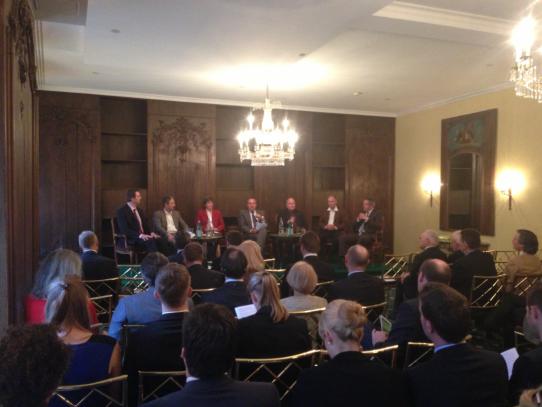
alpha3Having sufficient equity capital and access to long term credit lines are important for any company’s growth strategy. But there is this well-known German phenomenon,  this “fear” of capital markets and IPOs. According to studies, almost 70% of German companies solely rely on banks for their financing needs. But as it is becoming more and more difficult to get new capital through banks, another look has to be taken at the capital market and what it has to offer. All the more interesting was a panel discussion I attended last week in Munich with German Mittelstand and family entrepreneurs on exactly this topic.

The German capital market  and its exchanges are not being as positioned as positively as the UK or US ones so  there still is a lot of skepticism ranging from the possibilities to the requirements capital market financing brings with it. Many family owned businesses do not want to lose their independence, their majority vote. Entrepreneurs also are much more emotional, building up and relying on networks, in comparison to externally managed corporations. Being visible on the capital market as a company means that revenues and returns are in focus, one has to be more transparent.  One has to be truly present in the public eye. Many family owned companies do not want that kind of exposure. These and other topics were discussed with the general outcome being that these are fears that can easily be alleviated. For instance through better education from the German stock exchanges about financing possibilities as well as their actual requirements and what this means for the MIttelstand. Being listed can bring many positive aspects to these companies such as succession planning or the ability for greater international expansion and, most importantly, not having to rely on bank financing alone.

(thanks to ALPHAZIRKEL for organizing another great evening!)

B2B is P2P

lightThis week, I was wondering why marketers often make a distinction between B2C and B2B. Yes, there may be a difference in purchasing decisions. More logic, less emotion. But even if the name is “B2B” you are still selling to people, not businesses. And these people are also consumers who have daily interactions with the B2C greats like Apple or Amazon and therefore most likely have certain expectations about the sales and marketing process. Across the board they are looking to build relationships, gain insights and knowledge and develop loyalties. So when looking for best practices in B2B marketing, we should definitely take a look and see what we can learn from B2C companies.

Content definitely is a cornerstone for both marketing practices. For B2B it is about showing your expertise and core business values. Good (and plenty!) content can help you stand out among the large flow of information that is out there. So we need to create opportunistic content that revolves around news, visions and trends, finding the right distribution channels and tools. Content that stands out and is consistent over time will be a clear winner. Paired with B2C inspired social media  strategies we can create engagement with our audience. And engagement in turn creates communities.

Our audience should be more than just faceless readers of our content. B2C communities give their audience an opportunity to engage with the brand. In B2B our opportunity exists in creating a real network of customers, influencers and other interested parties where we can share information, developments and comments.I am convinced we can transform businesses and how we market them by taking a closer look at the B2C market and using the inspiration to create a competitive advantage.

Put an end to the old days of marketing!

westThis week I remembered the “good old days” of marketing where when asked to set up a marketing plan we would talk direct mailings (printed! sent via mail!), classic advertisements, printed newsletters or even “give a ways”.

This has all changed with the arrival of online marketing, social media and the ability to actually measure success. And with it, we have seen a shift in marketing focus. We can now truly connect with our customers, strengthen our relationships and improve customer service and products. We can be nimble and adapt quickly to changes in the market or when we see that our approach is not really reaching the customer in ways we want to. Great progress, right? But for some reason there are still many people in marketing out there who for some reason do not grasp the dynamics of social marketing. Maybe they prefer the good old days, with geeky ads in magazines we never were able to know the value of, maybe they are just scared.


In my opinion, us “old” marketers must really stop looking back at the old school of marketing techniques. Yes, there still are many tools out there from way back when that are still efficient. But the new marketing – which really is effective marketing – allows us to make connections that we were never able to build in the past. Having an online presence is just as important as having an offline one. Online gives us an opportunity to be transparent and to influence. It helps us in managing our competitive
advantage on a daily basis. We can measure market share, revenue growth and return on investments. It allows us to develop a strategy and to control execution. Yes, it may mean additional considerations, time spent and input. But with it we become greater influencers. And what is not to like about that?

It’s a bird, a plane…no it’s your marketing team!

Marketing can transform how a business leads. That should be somewhat of a mantra for us marketers. And not only for motivational purposes. ironman
Marketing is a key driver to growth, market share, brand awareness and revenue.Therefore, it is even more important to put together a top class team that understands the value and purpose of marketing as well as has an appreciation of it.  Because marketing is not a discipline “anyone” can do.

So does your marketing team understand your business? Do they have a vision of what they want to achieve? Do they know how to reach your customer and how best to communicate with them? Does your team have enough and varied experience to understand the different marketing channels? Are they adaptable, assertive and quick? Do they want to learn and grow? And finally, and most importantly, do they really understand the sales environment because marketing can only be truly successful if it works in unison with sales.

Your marketing team should be like Marvel Superheros – a group of talented, maybe sometimes flawed, persons coming together to “save the world”. For some super heroic inspiration you may want to read “Avengers Assemble: Putting Together a Superheroic Marketing Team”  – which superhero are you in your team?

It’s all about the brand

gmundLast week I attended a very interesting panel discussion about “Brands, Niche and Manufacturing”.

The discussion took place at the Buettenpapierfabrik Gmund near Tegernsee in Bavaria, a paper manufacturer of fine, hand made papers. Fun fact: they delivered the envelopes for this year’s Oscars!
Present on the panel were, among others, representatives from Gmund, liquor producer Underberg and fashion label Rena Lange. All these brands are in a niche, and they all have a very long entrepreneurial family history.

Some of these brands though only recently started to develop from family names into true brands. Many had grown up with the company and obviously the brand had become somewhat of a self-imposed responsibility. But all agreed that niche brands need to create passion, satisfaction and happiness. They have to stay true to their heritage and make their mark in the niche through quality, pricing and their uniqueness. And as history evolves so should the brand.

An important aspect was the important role customers play for niche brands. Everyone confirmed that the best strategy was to make the customer be the brand advocate. In order to do so, companies need to build up a close proximity to the customer, get to know them, their needs, their lifestyle and use it to incorporate it into the brand image. Excellent public relations was another vital point during the discussion. Good PR, as we all know, is worth more than any spending on advertising or media campaigns  The challenge of course is to keep a constant level of PR and through it  grow the value and trustworthiness of the company and its brand. But it was interesting to hear, that PR is only good when the entrepreneur, the brand owner, gets truly involved. All agreed that agencies (advertising or PR) were helpful but were never able to push the brand and live the brand as good as the company itself.

When asked about budget, and spending, the general opinion was that the most important investment  is into creating an image. Even if this is “only” less than 8% of the overall budget. The panel – much to my pleasure – siad that it was wrong to immediately expect an ROI and that one needed to be patient and consistent. Gmund’s MD Florian Kohler said that one should look at investing in brand image similarly to investing into new machinery. You know that you need it and you can write it off over the years – all the while you are actually creating an asset. And that is what building a brand is all about. It is creating an asset, if not the most important asset of your company. And if you get engaged in and with your own brand this is immediately reflected on the customer.

As a marketer a truly inspiring evening – thank you to Alphazirkel for the great organization!

Life in the B2B lane

b2bSales decisions in B2B marketing take much longer than in B2C. The customer wants to get to know you, to understand your business. And unlike in B2C, where a bad purchase decision is quickly forgotten, this can have a much more detrimental effect for B2B.

So it is important for marketers to reflect this in their social media and content marketing strategy. What customers want is information  Not only about this product or that service. They want to understand the business, the people behind it, their experience, know how and expertise and how it is relevant to them or even how it can help grow their own business. Or in other words, they want to build up a long term relationship. Something to keep in mind when deciding what to publish and where.